
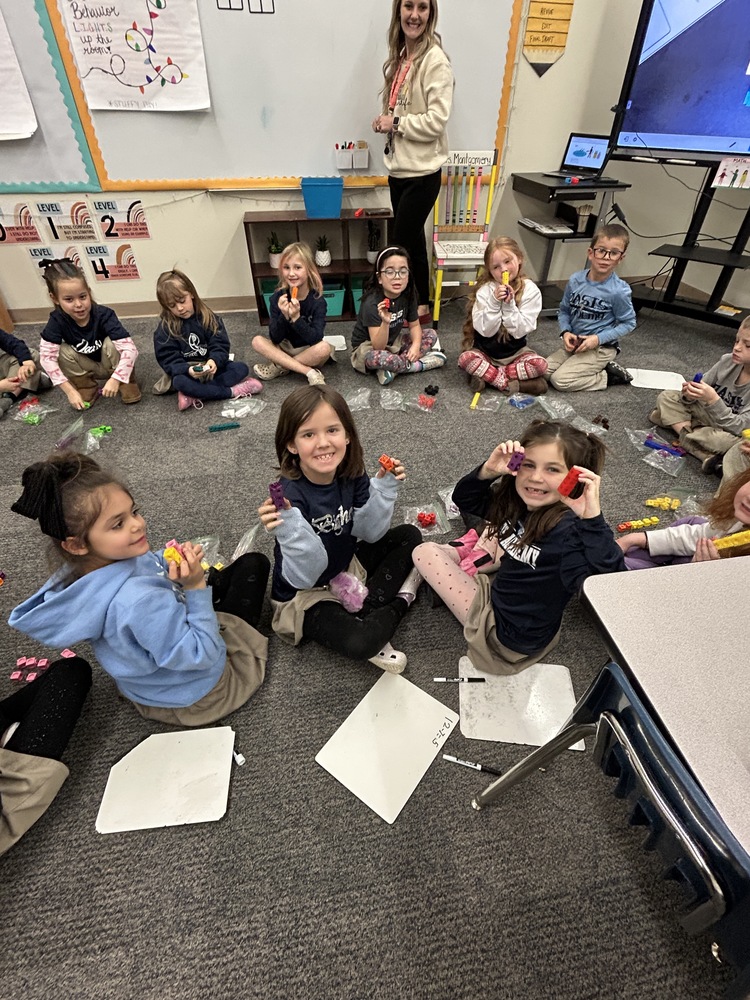
First-graders proved that big thinking can come in small packages. As part of the Singapore Math curriculum, students explored how knowing one equation can help solve another—building confidence and a strong foundation in mathematical reasoning.
The lesson centered on a simple but powerful idea: relationships between numbers. Students first learned that 10 − 7 = 3. With that fact firmly in place, they were guided to discover a new equation: 12 − 7. Rather than starting from scratch, students used what they already knew. 12 is made up of 10 and 2. If they take 7 from the 10, they easily know that’s 3, then they combine it with the 2 they still have, so 3 + 2 makes 5.
To make their thinking visible, students used linking cubes, a popular math manipulative. By physically modeling the equations, they could see how breaking apart the 12 made it possible to use their already known fact, 10-7. Students worked together to remove and count pieces, explaining their thinking to classmates and teachers along the way.
The lesson reflects a key principle of the Singapore Math curriculum, which emphasizes deep understanding, problem-solving, and making connections between concepts. Instead of memorizing isolated facts, students learn to build on what they know.
“We have spent the last three or four years digging deep and working to understand the Singapore approach,” said Kim Sorensen, Math Specialist. “I am amazed at the conversations and reasoning that are being used in classrooms to discover math.”
Sorensen added how visual learning tools, like the cubes, help students better understand and enjoy math.
“I love watching our teachers using manipulatives consistently, despite the challenge. For many kids, it’s the first time they can really see the math. When that happens, students are more apt to apply it - and they even find that they enjoy doing it,” she said